Report 33 · Line Graph
Question
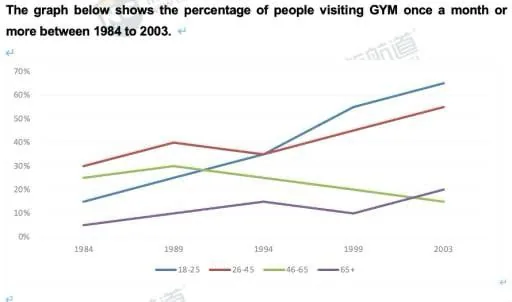
The graph shows information about the percentage of people visiting GYM once a month or more between 1984 to 2003.
Select text to highlight or save a word. Click a highlight to remove it.
The report provides information about changes in the share of 4 age groups who visited gym once a month or more from 1984 to 2003 in the line graph. Age groups mentioned are 18-25, 26-45, 46-65, and lastly over 65 year-old brackets. Generally speaking, the attendance ratio to the gym rose, albeit at varying degrees, across all age groups, except for those aged 46-65 - the age profile with the least involvement in gym activities over the period. It was the youngest age profile, however, which showed relatively higher percentages of gym goers. It is evident that visiting gym was quite popular among young individuals. For instance, starting at 15% in 1984, the figure for 18-25 year-old people surged at an unprecedented rate up to nearly 70% in 2003: it accounted for the all-time high share of gym visitors in the chart. As for another young age profile (26-45), after going up from 30% - the highest share of gym goers in 1984- to 40% in 1989, There was a marginal decline to 35% in 1994. This, however, quickly managed to recover and experienced a significant rise to 50% in the end: this age group came a close second in terms of gym engagement in that year. Moving on the results of senior attendees, around 25% 46-65 years old elderly visited gym in 1984, which edged up to nearly 30% in 1989. From this point on, attending the gym started to go down for this age profile at a noticeable level till 2003, recording only 15% of gym goers. The eldest age group (above 65) recorded the lowest participation figures from the period 1984 to 1999: despite this, participation among this cohort fluctuated: it rose from 5% to a peak of 15% in 1994, before declining back to 10% in 1999. By 2003, The amount of elderly gym attendees at above 65 years old had revised upwards and exceeded that of previous age group, up to 20%.
Key Vocabulary
14 expressions from this report
revised downwards
formal, statistical expression for “declined.”
clinching top spot
idiomatic and dynamic phrase meaning “ranked first.”
rose significantly to the same number
precise structure for describing comparison and growth.
up from 150 in 1985
common academic phrasing for numerical contrast.
albeit initially securing the clinching top spot
refined concessive structure for contrast.
the reverse was true for...
elegant phrase to highlight opposite trends.
sustained trajectory
advanced phrase for describing steady change.
throughout that time frame
formal phrase meaning “during that period.”
dipped radically
vivid way to express sharp decline.
leapfrogged to a high of...
strong visual verb meaning “surpassed quickly.”
hitting a trough of...
idiomatic way to indicate the lowest point.
fluctuated over the period
standard and academic phrase for irregular change.
negligibly leaned towards
sophisticated wording for a slight movement or change.
remained flat at...
concise phrase to indicate stability or no change.