Report 30 · Process
Question
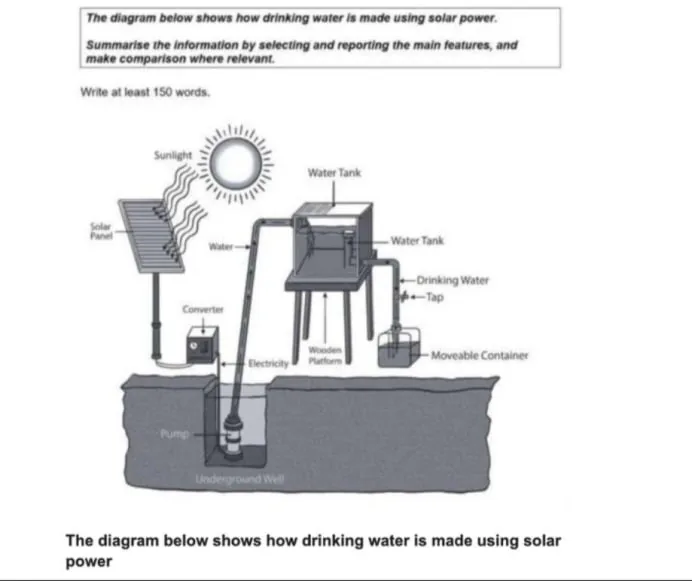
The diagram below shows how drinking is made using solar power.
Select text to highlight or save a word. Click a highlight to remove it.
The report gives information about the extraction of drinking water via the use of solar power as it is shown in the diagram. In general, the water processing is rather sophisticated, comprising several stages: firstly, energy is provided through solar panels, which is followed by extracting underground water, and finally storing this water. The process is fully automated with the use of several equipment and tools and is completely energy-self-sufficient. It all begins with the solar panels which are placed to capture solar lights and channel energy obtained to the converter, a device that helps to turn solar energy to the one that can be later used to generate electricity. The device is often based near an underground well so as to provide electricity travelling to a pump - it is laid under water. Then water journeys to the water tank, which is positioned on the surface several heights above the ground fixed to the wooden platform. Inside of the tank, there is a special tube, once filled with enough water, that directs water either to the tap to access water easily or the mobile container to store drinking water.
Key Vocabulary
15 expressions from this report
temporary migrant workers
people who move to another country for short-term employment.
short-term contracts
work agreements lasting a limited period.
universal growth
increase happening in all categories or places.
by far the largest rise
the biggest increase among all.
hosted the most significant number
had the highest quantity or total.
migrant-friendly country
a nation open to or supportive of foreign workers.
ratio of workers per 1,000 inhabitants
number of workers compared to the total population.
accounted for
represented or made up a specific amount.
followed the suit
behaved in the same way as others.
hit a meager (number)
reached a small or low figure.
marked result
clear or noticeable outcome.
displayed the lowest result
showed the smallest figure.
points lower
used to compare numerical differences.
reverse trend
opposite direction or pattern in data.
the fewest count
the smallest recorded number.