Report 247 · Bar Chart
Question
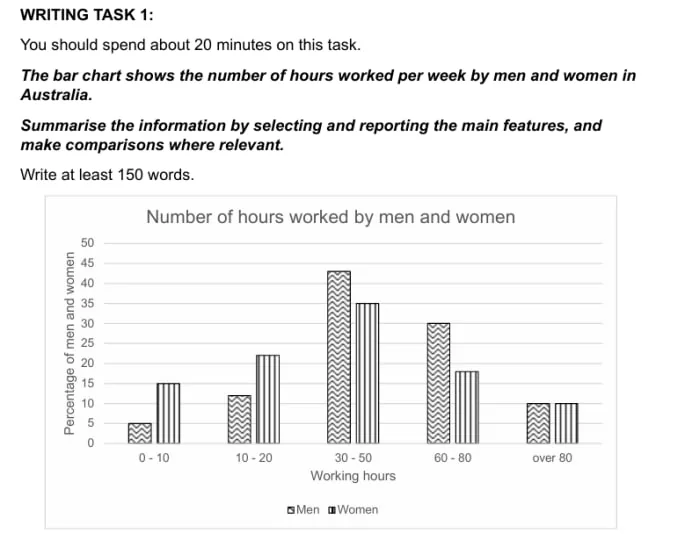
The bar chart below shows the number of hours worked per week by Australian men and women, in percentages.
Task wording reconstructed from the answer — the exam version may be phrased slightly differently.
Select text to highlight or save a word. Click a highlight to remove it.
The report outlines information regarding the volume of weekly work-hours in 5 categories, in percentages, by Australian men and women in the bar chart.
Generally speaking, the share of women working up to 20 hours was much greater than that of men, while the reverse was true for men in longer work-hour brackets. When it came to working over 80 hours per week, however, a similar share was seen among both genders.
In the two lowest bands (0–10 and 10–20 hours per week), women accounted for the largest proportions, at around 15% and nearly 25% respectively. By comparison, the figures for men were much lower, at roughly 5% and just over 10%.
Men,however, dominated the mid-range category of 30–50 hours, where their share rose to about 45%, compared with 35% for women. The difference became more pronounced in the 60–80-hour bracket: men made up approximately 30%, while women stood at around 15%, a gap of about 15 percentage points.
At the upper extreme, the proportion working over 80 hours was identical for both genders, at 10%.
177 words
Useful to learn is: the share of women — the proportion of females
working up to 20 hours — working no more than 20 hours
was much greater than — was substantially higher than
the reverse was true — the opposite pattern held
in longer working hours — in higher-hour brackets
when it came to — regarding / in terms of
a similar share was seen — a comparable proportion was recorded
among both genders — for men and women alike
the two lowest bands — the smallest hour ranges
accounted for the largest proportions — made up the biggest shares
at around / nearly — approximately / just under
respectively — in the same order
By comparison — in contrast
much lower — considerably smaller
just over — slightly above
dominated the mid-range category — led the middle bracket
where their share rose to — with their figure reaching
compared with — versus
became more pronounced — widened noticeably
the … bracket — the … range
made up approximately — accounted for about
stood at around — was roughly
a gap of … percentage points — a difference of … points
At the upper extreme — in the highest band
was identical for both genders — was the same for men and women