Report 244 · Bar Chart
Question
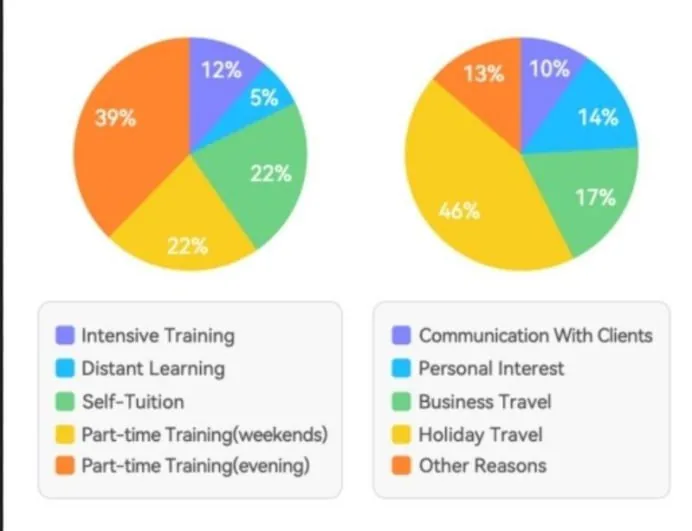
The chart below shows the types of communication training taken by employees in an international company and the reasons why they took part in this training.
Select text to highlight or save a word. Click a highlight to remove it.
The report outlines information about what sorts of communication training and why employees in an international company participated, in percentages, as shown in the pie charts.
Generally speaking, evening part-time sessions were by far the most opted option by attendees, followed by sessions at weekends and self-tuition, whereas it seemed that distant learning was relatively less popular among workers. Notably, respondents cited holiday travels as the leading motive to take part in the training, with other categories making up somewhat similar shares: the smallest share of respondents came to say that communication with clients was the factor for their participation.
Focusing on sorts of communication training, evening part-time sessions were the most popular option, as 39% of participants were attending it, while the share of those taking part in weekend part-time sessions and those who did self-study followed in the close second, making up a similar share of 22%. A third spot was secured by the proportion of participants in intensive training, with a distant learning distant last (12% vs 5% respectively).
Almost half of the attendees said that their primary reason to attend communication training was going on holidays (46%), and training for business travels was the second most popular reason (17%). This was 4 percentage points lower for those who reported personal reasons, and 4 points lower for other undefined reasons. It appears that one respondent in ten participated in the training due to client-facing communication needs.
239 words
Useful to learn from this report is: by far the most opted option — the clear most popular choice
among attendees — among participants
followed by — ranked next / came second
whereas it seemed that — whereas it appeared that (soft contrast)
relatively less popular — comparatively unpopular
respondents cited … as the top reason — participants named … as the main motivation
the top reason — the leading motive
other categories making up somewhat similar shares — the remaining reasons accounted for comparable proportions
the smallest share of respondents — the lowest proportion of participants
focusing on — turning to / looking at
training formats — modes/types of training
the share of those taking part — the proportion participating
followed in close second — came a close second
making up a similar share — accounting for an almost identical percentage
a third spot was secured by — ranked third
a distant last — well behind / in last place by a wide margin
almost half of the attendees — just under half of participants
primary reason — main reason / chief motivation
the second most popular reason — the runner-up motive
percentage points lower — a gap measured in points
reported personal reasons — cited personal motives
other undefined reasons — unspecified/other reasons
one respondent out of ten — around one in ten
due to — because of / on account of
communication with clients — client-facing communication needs