Report 241 · Mixed
Question
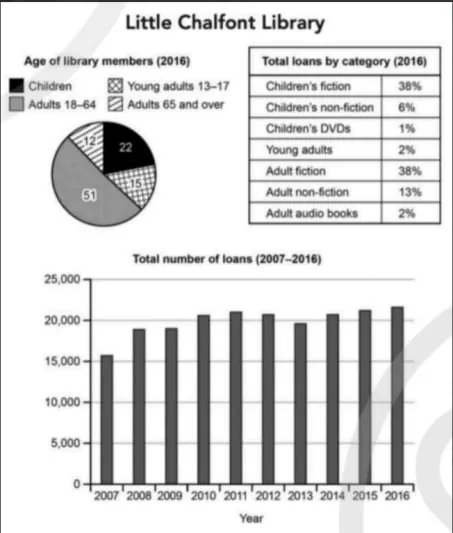
The charts below give information about Little Chalfont library: the ages of its members in 2016, total loans by category, and changes in the total number of loans from 2007 to 2016.
Task wording reconstructed from the answer — the exam version may be phrased slightly differently.
Select text to highlight or save a word. Click a highlight to remove it.
The report outlines information regarding Little Chalfont library, including the age of library members in 2016 along with the total loans by 7 categories , and also the change in the total number of loans from 2007 to 2016.
In general, adults from 18 to 64 appeared to be the primary members of the library, followed by children, and a quite similar share of young adults (13-17) and the eldest group (65 and over). Plus, the most popular choices of books borrowed were children’s and adult fiction, while the interest in DVDs for children was close to none. Notably, the amount of loans in the library increase pretty noticeably over the period.
Regards with the age of library members in 2016, the jaw dropping share was responsible for adults aged 18-64, accounting for 51%. A share of children, while showing a huge gap, followed behind, at 22%. This was 7 percentage points higher than that of young adults between 13 and 17 (15%) and 10 percentage points higher that of seniors at 65 and over that (10%).
In the same year, 38% of books on loans were children’s fiction as well as adult fiction, making them them the most opted type of books. Another popular type of books were adult non-fiction (13%), while the share of children’s non fiction comprised around only 6%. A similar share was marked by children’s DVDs (1%), young adults (2%), adult audio books (2%).
Between 2007 and 2009, the total amount of loans exhibited an upward trend, though there were years of exceptions. For instance, while around 15 000 books were borrowed in 2007, the result of which rose to just above 20 000 in 2010, it again marginally edged up till 2013, to jus under 20 000. However, the number of books borrowed recovered thereafter, rising to about 22 000 in 2016.
308 words. 19 minutes
Chunks and vocabulary to learn from this report are: appeared to be the frequent visitors — seemed to be the most regular users followed by — ranked next / came second a quite similar share — a comparable proportion the eldest group — the oldest age bracket the most popular choices — the most commonly selected categories books borrowed — items checked out / taken on loan close to none — negligible / almost zero the amount of loans — the total number of items borrowed increased pretty noticeably — rose markedly / climbed clearly over the period — across the timeframe with regard(s) to the age of library members — looking at the age profile of members a jaw-dropping share — a strikingly large proportion was responsible for — accounted for / made up accounting for 51% — representing just over half showing a huge gap — with a sizable difference followed behind — trailed (came after, at a lower level) percentage points higher — a gap measured in points, not percent on loan — currently borrowed / checked out making them the most opted type — making them the most frequently chosen category comprised around only 6% — accounted for roughly 6% a similar share was marked by — a comparable proportion was recorded for exhibited an upward trend — showed an overall rise years of exceptions — periods where the pattern briefly broke rose to just above — climbed to slightly over marginally edged up — increased slightly recovered thereafter — picked up again afterwards
YOUTUBE VIDEO