Report 236 · Bar Chart
Question
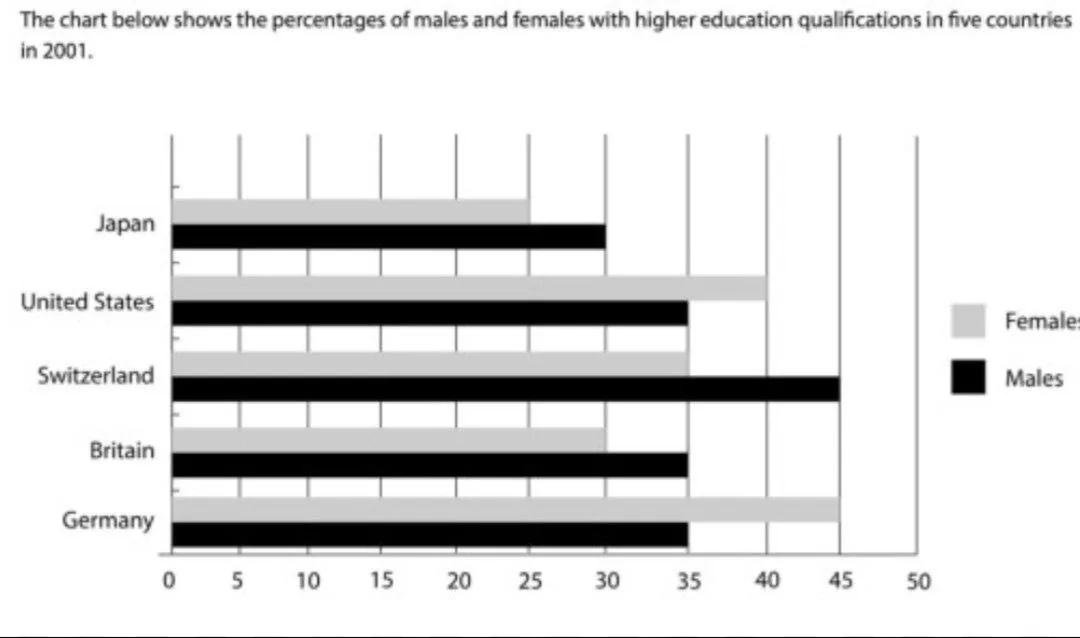
The chart below shows the percentages of males and females with higher education qualifications in five countries in 2001.
Select text to highlight or save a word. Click a highlight to remove it.
The report compares percentage terms of men and women with higher education qualifications in Japan, United States, Switzerland, Britain, and Germany in 2001 in the bar chart.
In general, Switzerland, out of five countries, was the one with the highest ratio of highly educated men, while Germany represented the same pattern for women. Apart from United states and Germany, there were more male degree holders in other three countries. Strikingly, the figure for Japan, regardless of categories, bucked the trend.
Looking at male degree holders around countries, Switzerland held the top sport, with 45%, while this was down by 10% in United States, Britain, and Germany, with Japan following with a margin of only 5 percent points.
With regards females with higher education, Germany had the highest ratio, with 45%, followed closely by that of United States (40%). Switzerland came next in the list, where 35% of women were highly qualified, and the figure dropped further 5 percentage points in Britain (30%) and 10 percentage points in Japan (25%).
169 words
What can be learnt from this report is:
Switzerland, out of five countries, was the one with the highest ratio — led the group (ranked first among the five)
The highest ratio of highly educated men — the largest proportion of male degree-holders
Germany represented the same pattern for women — Germany topped the female category as well (showed the leading figure for women)
Apart from the United States and Germany — with the exception of those two countries
There were more male degree holders — men outnumbered women in degree attainment (higher male share)
In other three countries — in the remaining three nations (the rest of the sample)
Strikingly, … bucked the trend — notably, it went against the general pattern
Regardless of categories — for both genders / in both groups
Looking at … around countries — considering the cross-country comparison
Held the top spot — ranked first (had the highest figure)
This was down by 10% — was 10 percentage points lower (a gap of ten points, not necessarily a “drop”)
With Japan following — Japan came next (ranked after the preceding countries)
With a margin of only 5 percentage points — by a narrow gap of five points
With regards (to) females with higher education — turning to women’s higher-education figures
Followed closely by — came just behind (a small difference)
Came next in the list — ranked third (the subsequent position)
Dropped further by 5 percentage points — fell by an additional five points (a further decrease in rank/value)