Report 23 · Bar Chart
Question
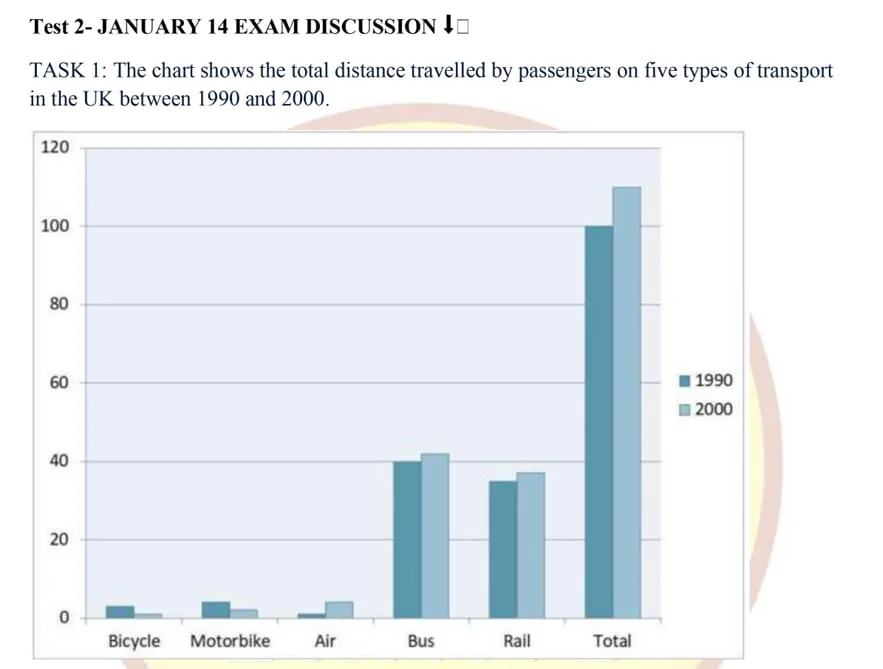
The chart below shows the total distance travelled by passengers on five types of transport in the UK between 1990 and 2000.
Select text to highlight or save a word. Click a highlight to remove it.
Interestingly, the figure for air commuting, albeit being public transit, was also less marked compared to other modes of travel. Plus, the total figure for traveled distance rose at a moderate rate over the years in the question, with that of bus, rail, and air marking the same trajectory. The exceptions in this regard were motorbikes and bicycle.
Focusing on by far the most popular means of transport, most people chose bus, with its figure accounting for 40 in 1990 and 45 in 2000. The distance ratio on rail came as the second with the upward trend over the years, rising from 30 to 35. The distance milage was much less pronounced for other transport means, where that of air exhibited a growth from a meager 2 to 5 from 1990 to 2000 contrary to what the result of motorbike and bicycle showed - the decline in public preference during the period. The former halved drastically from 7 to 3, while the latter mirrored the movement down to 2, up from 6. In total, distance covered by all transportation means constituted a remarkable 100 in 1990, the figure for which then rose to a high of 110 in 2000 in the UK. (
Key Vocabulary
15 expressions from this report
Outlines
gives a general description or summary of something.
Proportions
the percentage or part of a whole.
Institutions
organized places of learning, like schools or universities.
Commonplace
happening often; very common.
Disparity
a noticeable difference between two or more things.
Identical
exactly the same or equal.
Turning to details
a linking phrase used to introduce specific information.
A mere
used to emphasize how small a number or amount is.
Gap
a difference between two figures or groups.
Shrunk significantly
became much smaller or less noticeable.
No difference at all
completely equal in amount or number.
Namely
used to introduce specific examples or items.
Consisted of
was made up of; formed by.
Accounted for
represented or made up a certain percentage.
By far the largest
used to emphasize the most extreme or highest value in comparison.