Report 17 · Bar Chart
Question
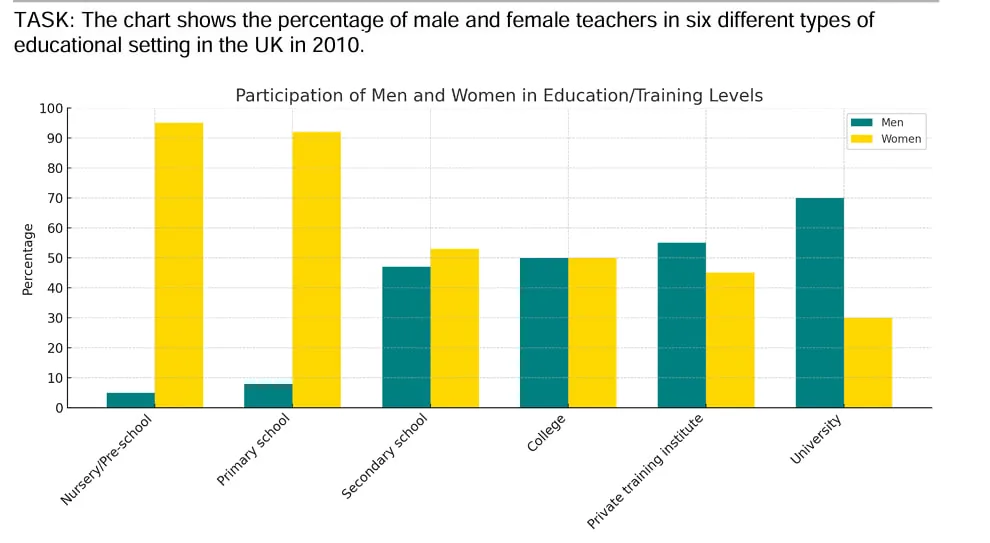
The chart shows the percentage of male and female teachers in six different types of educational setting in the UK in 2010.
Select text to highlight or save a word. Click a highlight to remove it.
The report outlines data regarding proportions of male and female teachers in different types of institutions - Nursery/pre preschool, primary school, secondary school, colleges, private training institutes, and lastly universities - in the UK in the year 2010 in the bar graph. Overall, female teachers were more commonplace in nursery, pre schools and primary schools than male teachers, as the age was an important factor, showing a higher percentage of female teachers for younger students, However, a higher percentage of older students were taught by male teachers, such as the ones in the university. There was, interestingly, a little disparity between the proportions of male and female teachers in institutions like secondary school and private training institutes, whereas the proportion of both genders was identical in colleges.
Turning to details, at the youngest level of education - nursery/pre school, nearly 95% of teachers were females, while a mere 5% of male teachers worked there. A quite similar gap can be observed in primary schools, with an increase in the proportion of male teachers ( 8% males vs 92% females). However, the difference between men and women shrunk significantly in secondary schools (47% and 53%), and there was no difference at all in colleges. Regarding to the remaining educational settings, namely private training institutions and universities, there were more men as teachers than women. In the former educational setting, 55 % of teachers consisted males, and 10 points lower were females, while in the latter these figures accounted for a hefty 70% males and 30 % females - by far the largest percentage of men as teachers in one institution as opposed to other settings. 274 words.
Key Vocabulary
10 expressions from this report
Proportions
the percentage or part of a whole
Institutions
organized places of learning, like schools or universities
Commonplace
happening often; very common
Disparity
a noticeable difference between two or more things
Identical
exactly the same or equal
Turning to details
a linking phrase used to introduce specific information
A mere
used to emphasize how small a number or amount is
Gap
a difference between two figures or groups
Shrunk significantly
became much smaller or less noticeable
No difference at all
completely equal in amount or number