Report 15 · Mixed
Question
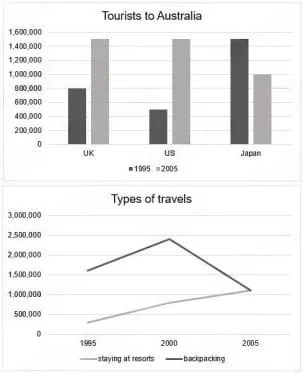
The charts below show the number of tourists to Australia from three countries in 1995 and 2005, and the types of travels between 1995 and 2005.
Select text to highlight or save a word. Click a highlight to remove it.
The charts present visitor numbers to Australia from three countries — The UK, The USA, and Japan — in 1995 and 2005, along with data on travel preferences between these years. Overall, there was a pronounced growth in visitor numbers from both The UK and The USA over the years, whilst the reverse is true for Japan. Regarding travel types, backpacking numbers — unlike staying at resorts — experienced a downward trend during the period, remaining more popular than staying at resorts though.
With regard to country-specific visitor trends, Japan dominated in 1995 with approximately 1.6 million tourists, substantially exceeding both The UK and The USA. British visitor numbers stood at 0.8 million — 0.35 million higher than American visitors at 0.45 million. By 2005, the situation had reversed notably. A similar number of 1.5 million visitors was recorded by both The UK and The USA, experiencing a drastic increase, while the figure for Japan exhibited the opposite trend, declining to 1 million tourists.
Backpacking was the all-time preferred form of travel from 1995 to 2000. Starting at just above 1.5 million, the trend rose by nearly a million in 2000, representing the peak for this travel type. However, this was followed by a noticeable drop to almost 1 million in 2005. Resort stays, by contrast, showed a steady increase throughout the period, rising from 0.5 million in 1995 to 1 million by 2005. At this point, backpacking and resort stay numbers were identical.
Key Vocabulary
10 expressions from this report
overall
used to give the main trend or summary
downward trend
a general decrease over time
followed by
coming after another category in rank or sequence
rose by
increased by a particular amount
reverse is true
the opposite situation applies
travel preferences
the types of travel or transport people choose
visitor numbers
the number of people visiting a place
pronounced growth
very clear and noticeable increase
visitors was recorded
used when stating the number of visitors counted in a period
tourists substantially exceeding
tourists being much greater in number than others